
Core Value and Selection Logic of Surface Treatment for Press-Fit Holes
In the PCB press-fit technology system, surface treatment is a core link that determines connection reliability, mechanical service life, and electrical performance. It is not a single process option but a key step that requires systematic decision-making based on application scenarios, cost budgets, and connector characteristics. Different surface treatment methods vary significantly in terms of friction coefficient control, oxidation resistance, and contact resistance stability, directly affecting the insertion force, retention force, and long-term service performance of press-fit holes.
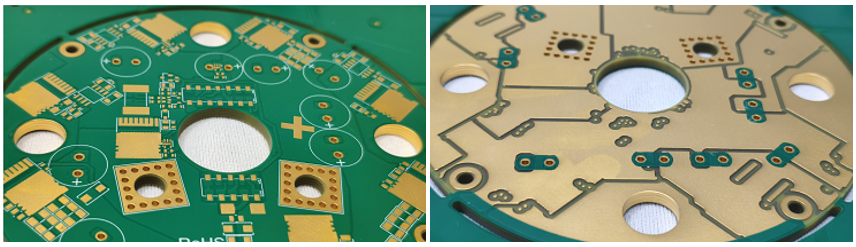
(The above picture shows 3 pieces 11.00mm+0.09/-0.00mm Press-fit holes)
In-Depth Performance Analysis of Mainstream Surface Treatment Technologies
| Surface Treatment Type | Core Process Description | Key Performance Advantages | Main Applicable Scenarios | Technical Challenges & Considerations |
| Non-Plated Through Hole (NPTH) | Hole walls are not electroplated after drilling, directly retaining the epoxy/glass fiber base material state. | - Simplest process, lowest cost | - Standard backplane connectors | - Extremely high hole wall quality requirements: Must be free of drill residue, burrs, with strict roughness control |
| - Avoids insertion force fluctuations due to uneven plating thickness | - Board-to-board connections | - Pure mechanical contact, performance highly dependent on pin coating | ||
| - High reliability when matched with dedicated elastic coating pins | - Cost-sensitive consumer electronics, general industrial equipment | - No solderability, incompatible with soldering processes | ||
| Organic Solderability Preservative (OSP) | A thin organic protective film is coated on the hole opening and surrounding copper rings to prevent copper oxidation. | - Effective oxidation prevention, maintains clean copper surface during storage | - High-density consumer electronics | - Thin film, limited pluggable cycles |
| - Provides stable friction coefficient, making insertion force more controllable | - Automotive electronics with balanced cost and reliability requirements | - Short storage validity period (typically 6-12 months), requires humidity control | ||
| - Environmentally friendly, low cost | - Mixed process PCBs with press-fit and soldering | - Film punctured during press-fit, poor quality may leave debris affecting contact | ||
| - Compatible with subsequent soldering processes | ||||
| Electroless Nickel Immersion Gold (ENIG) | Chemical nickel (2–5μm) is deposited on copper layer as barrier layer, followed by immersion gold coating (0.05–0.1μm). | - Superior long-term reliability: Extremely strong oxidation and corrosion resistance of gold layer | - Communication base stations, 5G equipment | - Highest cost |
| - Stable contact resistance over time, suitable for harsh environments | - Automotive ADAS, engine control units (ECU) | - Complex process, risk of "black pad" defects, requires quality supplier | ||
| - High hardness nickel layer, excellent wear resistance, supports multiple pluggings | - Aerospace and defense electronics | - Hard coating, may require adjustment of press-fit parameters to prevent pin or hole wall damage | ||
| - Flat surface, suitable for high-density and high-frequency applications | - Industrial control core modules | |||
| Selective Electroplating / Local Metallization | Only the two ends of the hole (contact areas with pins) are electroplated, while the middle hole wall remains non-metallic. | - Precise balance between electrical and mechanical performance: low resistance at ends, strong grip at middle | - Mixed demand scenarios requiring both end electrical connection and hole wall mechanical fixation | - High process control difficulty, requires precise alignment of electroplating area |
| - Saves material and cost compared to full-hole electroplating | - Complex communication equipment backplanes, industrial control modules | - Deviation in electroplating range easily causes performance instability or failure | ||
| - Can optimize signal integrity | - Equipment and process requirements high, yield control challenge | |||
| Immersion Silver | A thin silver layer (0.1–0.3μm) is formed on copper surface through chemical displacement reaction. | - Excellent conductivity, low high-frequency signal loss | - High-frequency communication equipment, RF modules | - Silver layer prone to sulfide reaction causing "sulfurization darkening", affecting long-term reliability |
| - Flat surface, suitable for high-density layouts | - High-speed backplanes with signal integrity requirements | - Storage requires low-sulfur, dry environment | ||
| - Certain solderability, compatible with mixed processes | - Oxidation resistance far inferior to ENIG, unsuitable for high temperature and humidity environments |
Selection Decision Framework for Surface Treatment of Press-Fit Holes
| Application Scenario | Recommended Surface Treatment | Reason |
| High Reliability, Long Life, Harsh Environments (e.g., automotive, industrial, communication) | ENIG | Provides best oxidation resistance, wear resistance, and long-term contact stability, is the preferred choice for high-end applications. |
| Cost-Sensitive, Short Lifecycle, Mild Environment | OSP or High-Quality NPTH | Achieves optimal cost control while meeting basic performance requirements. |
| PCB Areas with Both Press-Fit and Soldering | OSP or ENIG | Both are compatible with soldering processes, avoiding secondary treatments. |
| Dedicated Press-Fit Connectors (e.g., IEC standards) | NPTH (matched with gold-plated pins) | Classic reliable combination, relies on connector vendor specifications, no additional plating required on PCB side. |
| High-Frequency Signal Transmission Requirements | Immersion Silver or ENIG | Low signal loss, flat surface beneficial for impedance control. |
Key Points of Quality Control for Surface Treatment of Press-Fit Holes
Regardless of which surface treatment method is selected, quality control is the core of ensuring performance:
1. Hole Wall Pre-Treatment: After drilling, strict deburring and drill residue removal must be carried out to ensure that the hole wall roughness meets the design requirements and avoid residual impurities affecting the connection performance.
2. Coating Thickness Control: For electroplating treatments, the coating thickness must be precisely controlled. For example, the gold layer thickness of ENIG is usually controlled at 0.05-0.1μm, and the nickel layer thickness is controlled at 2-5μm to balance cost and performance.
3. Reliability Testing: Sample verification must be carried out before mass production, including insertion/extraction force testing, contact resistance testing, temperature-humidity cycle testing, vibration testing, etc., to ensure the stability of the surface
Actually I-tech often provides ENIG and immersion Silver surface finishing manufacturing based on customer requirement.